FUT Hair Transplant – Options for Men with Extensive Balding
For men with advanced hair loss (e.g., extensive Norwood patterns), a Uni-Strand® FUT session can safely move a much larger number of grafts in a single procedure, often at a lower total cost per graft than FUE, while our Uni-Strand® trichophytic closure technique camouflages the donor line by allowing hairs to grow right through the scar for a near-invisible finish[1, 2, 3].
Mega Sessions Without The Mega Scar
Uni-Strand® trichophytic Camouflages the Donor Scar
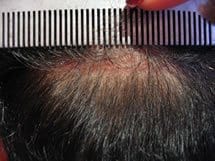
A special surgical maneuver called a trichophytic (pronounced “trick-o-fitic”) closure allows the skin to heal with hair growing through the scar, blending the line into surrounding hair and improving concealment[1, 2].
At Sure Hair®, we have refined this closure and employ it in virtually all strip (FUT) cases. Our precision suturing is designed to maximize the chance that “tricky” hairs grow right through the incision line for a soft, camouflaged result.
Why Choose Uni-Strand® FUT for Extensive Balding
Larger One-Session Graft Counts
FUT (strip) lets us harvest efficiently from the permanent donor zone and dissect under high-power microscopes, enabling high graft yields in a single sitting. This is especially valuable when coverage goals are ambitious across the front, mid-scalp, and crown[3, 4].
Practical takeaway: More grafts per session often means fewer total procedures to reach your target coverage—and better long-term donor management.
Better Lifetime Donor Management
For advanced hair loss patterns, international guidance notes that strip harvesting—and in some cases a strategic combination of FUT and FUE—can better preserve donor resources across a lifetime plan[4].
Uni-Strand® = Natural Hairlines + Strategic Density
With Uni-Strand®, each hairline micro-site is populated with single-hair follicular units for a soft, natural feathered edge. The naturally occurring 2–3 hair units are placed just behind the hairline and across mid-scalp/crown to build density—mirroring how hair grows in nature[5, 6].
Follicular Unit Hair Transplantation
These naturally occurring follicular units are the anatomical root systems of the hair beneath the scalp. Hair transplantation relocates these same root units to produce perfectly natural appearing hair growth; if done correctly, the final result is a virtually undetectable hair transplant.
Oftentimes, not even an “up close” inspection by your stylist or barber will yield tell-tale signs. The genetically DHT-resistant grafts will continue to grow like they did in the donor zone.
The Uni-Strand® FUT Procedure: What to Expect
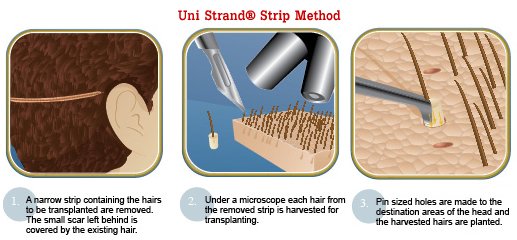
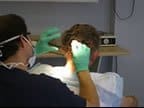
We begin by clipping a narrow donor lane at the back and/or sides (about 1 cm high × 6–30 cm long, based on graft goals). Surrounding hair remains untrimmed to conceal sutures post-op.
After comfortably numbing the area with local anesthetic, we remove a donor strip in one continuous piece to protect follicular integrity. We close with our refined trichophytic closure so hair can grow through the line and blend with adjacent hair[1, 2].
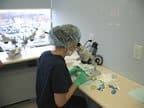
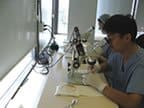
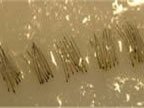
Under high-power microscopes, our team dissects individual Uni-Strand® single-hair grafts for the hairline and preserves multi-hair units for density zones. Grafts are held in a chilled, protective solution until placement.
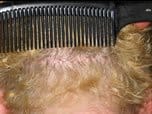
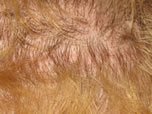
One-Year Post-Op: What Our Donor Closures Look Like
As these photos show, a proper trichophytic closure can leave a line that’s hard to find—even at short hair lengths—because the hair grows through the scar[1, 2].
FUT vs. FUE at a Glance
| Consideration | FUT (Strip) | FUE |
|---|---|---|
| Session size for extensive balding | Often allows higher graft counts in one session via efficient strip harvest and microscopic dissection[3, 4] | Usually staged over multiple sessions to avoid over-harvesting; good for smaller areas or when shaving is acceptable |
| Donor management over time | Excellent for maximizing lifetime donor yield; can be combined later with FUE if needed[4] | Great flexibility for targeted touch-ups; requires careful planning to prevent diffuse thinning of donor |
| Scarring | Single linear line; our trichophytic closure lets hairs grow through the scar for camouflage[1, 2] | Tiny dot scars spread across donor; very short fades may reveal a grainy appearance if over-harvested |
| Cost efficiency | Frequently lower cost per graft for larger sessions | Often higher cost per graft due to time-intensive extractions |
| Ideal candidates | Advanced patterns needing many grafts; patients prioritizing maximum coverage with minimal sessions[4] | Patients with smaller areas, strict “no-line” preference, or those planning staged refinements |
Advantages of the Uni-Strand® Strip Method
- Higher follicular unit yield per session, supporting broad coverage goals for extensive balding[3, 4].
- For many candidates, we can finish the target area in one session.
- Transplanted follicular units are from the permanent zone and designed to grow for life.
- Fewer total sessions typically required → lower overall treatment time/cost versus equivalent-coverage FUE.
- Trichophytic closure means a finer, better-camouflaged line because hair grows through the scar[1, 2].
- Up to 25% more hair per session than regular approaches (via optimized harvesting, microscopic dissection, and precise graft handling).
- FUT pricing is generally more economical per graft on large sessions; details: Hair Transplant Cost Guide.
FAQs
Who Is an Ideal Candidate for FUT?
- Men with advanced hair loss patterns aiming for broad coverage in fewer sessions[4].
- Patients who prioritize maximum donor preservation and long-term planning.
- Those comfortable with a single, well-camouflaged trichophytic line rather than thousands of tiny dot scars.
Will I be able to wear my hair short?
Is FUT more “natural” looking than FUE?
Can FUT and FUE be combined?
Hair Transplant Quote: Plus Save $2500
- Take the first step today; fill out the Online Consultation Form to get a no-cost, no-obligation hair loss consultation with a legitimate multi-board certified hair transplant expert. By filling out the form, you’ll reserve your place in our limited-time Winter special should you decide to proceed.
- The consultation is absolutely FREE, and for your convenience, you can schedule a photo consultation via phone if you can’t make it in person.
Your Free Consultation Will Provide You With:
- A personalized price/cost estimate for your pattern of hair loss and coverage goals.
- Direct answers from a top hair restoration expert.
- The latest treatment options—surgical and non-surgical—for now and the future.
- Clear financing options (if preferred).
- A forward-looking donor & future hair-loss assessment.
- An opportunity to join our limited-time special while supplies last*






References
- Nirmal B. A Study of Donor Area in Follicular Unit Hair Transplantation. PMC: hair grows through the scar with trichophytic closure and improves camouflage. :contentReference[oaicite:0]{index=0}
- Bernstein Medical. Trichophytic Closure: trimming the wound edge allows hair to grow through the scar for near-invisible lines. :contentReference[oaicite:1]{index=1}
- ISHRS. FUE vs. FUT and Maximizing the Hair Graft Harvest: discussion on maximizing graft yield and the role of FUT. :contentReference[oaicite:2]{index=2}
- ISHRS. FUE Clinical Practice Guidelines (2019): for advanced baldness, strip harvesting or combined approaches may be preferable to meet high graft needs. :contentReference[oaicite:3]{index=3}
- Khanna M. Hair transplantation surgery: single-hair grafts for the frontal hairline to achieve natural results. :contentReference[oaicite:4]{index=4}
- Jiménez-Acosta F. Follicular Unit Hair Transplantation: Current Technique: one-hair units at the hairline; larger units posteriorly for density. :contentReference[oaicite:5]{index=5}